Close-up of neck and shoulder in golden light — cover image of the Liposser body section

Twelve procedures

What each procedure does —
and when it is your moment.

Every clinic publishes the list. Almost none publishes who should walk away. Here you get both, for all twelve, along with the recovery time you should be planning your trip around.

How to read this page

Start with the area, not with the name

The procedures below are grouped by the part of the body they treat. Two people with the same complaint often need different operations — loose skin and stubborn fat look alike in a mirror and are treated in completely different ways. That distinction is the one this page keeps making, because getting it wrong is the most common reason a result disappoints.

Recovery times are ranges based on ordinary healing. Yours is confirmed in writing after your assessment, and if you are travelling, it is what your stay is planned around.

Study of a neck in warm light — atmosphere image, not a patient and not a result

Face and neck

Four operations that people tend to arrive calling by the same name. They solve four different problems, and only one of them may be yours.

Face and neck

Four procedures, four different problems

Facial ageing is not one thing. Sagging tissue, excess eyelid skin, fullness under the chin and prominent ears are separate problems with separate operations. Skin texture — fine lines, sun damage, pigmentation — is not fixed by any of them.

Face

Facelift (rhytidectomy)

A facelift repositions the deeper layer of tissue over the cheeks and jawline and removes the skin left over. It addresses sagging: jowls, a jawline that has lost its edge, deep folds beside the mouth. It does not change skin quality and it does not touch the eyelids or the forehead, which are separate procedures often done in the same session.

Usually a candidate

  • Sagging you can lift with your fingers in the mirror
  • Stable weight and reasonable general health
  • A non-smoker, or willing to stop several weeks before and after

Reviewed first if

  • The complaint is fine lines, texture or pigmentation — that is resurfacing, not surgery
  • You smoke and are not prepared to stop; healing of the skin flaps depends on it
  • You are hoping to look like a different person rather than a rested version of yourself
Recovery 3 weeks social
Eyelids

Eyelid surgery (blepharoplasty)

Removes the fold of excess skin on the upper lid and, on the lower lid, repositions or removes the fat that creates under-eye bags. It is the procedure with the largest visible change relative to how small it is, which is why it is often the first one people have.

Usually a candidate

  • Hooded upper lids, sometimes heavy enough to sit on the lashes
  • Under-eye bags that stay the same regardless of sleep or salt
  • Healthy eyes, with any dryness already under control

Reviewed first if

  • The real problem is a dropped brow pushing the lid down — that is a brow lift
  • You have significant dry eye, or a thyroid eye condition that is not stable
  • The concern is dark circles from pigment rather than shadow from a bag
Recovery 7–14 days
Neck & chin

Neck and chin (submental liposuction or neck lift)

A full neckline has three possible causes and each one is treated differently: fat under the chin, loose skin, or a lax platysma muscle showing as vertical bands. If it is fat with good skin tone, liposuction alone is often enough. If skin or muscle has given way, tightening is needed, and that overlaps with a facelift. This is the area where the assessment matters most, because the wrong choice produces a technically correct operation with a disappointing result.

Usually a candidate

  • A defined chin but no visible angle between chin and neck
  • Localised fullness that has not moved with weight loss
  • Skin that still springs back when pinched, for the liposuction-only route

Reviewed first if

  • Your weight is still changing significantly
  • The fullness comes from an enlarged gland rather than fat — that needs a different specialist
  • You want the result of a neck lift but only the recovery of liposuction
Recovery 5–10 days
Ears

Ear surgery (otoplasty)

Reshapes prominent ears by recreating the natural fold in the cartilage and bringing the ear closer to the head. It is performed on children and on adults; the ear reaches close to adult size early, so it is usually possible from around the age of six, which is also when children start to be affected by it socially.

Usually a candidate

  • Ears that stand away from the head, on one or both sides
  • A child of about six or older who wants the surgery themselves
  • Adults who have simply lived with it and decided to stop

Reviewed first if

  • It is the parents who want it and the child does not
  • There is an untreated ear infection or skin condition
  • You expect two ears that are identical; the goal is unremarkable, not symmetrical to the millimetre
Recovery 1 week off school

Breast

Volume and position are two different questions

An implant adds volume. A lift changes position. Many people need one, some need both, and telling which is which is done with a physical examination, not from a photograph. Current breast imaging appropriate for your age is part of the work-up either way.

Breast

Breast augmentation

Places an implant to add volume and improve shape. Three decisions drive the result: the size, which is limited by how much tissue you have to cover it; the plane, above or below the muscle; and the implant itself. Implants are not lifetime devices — at some point in your life, further surgery is likely, and any clinic that tells you otherwise is selling.

Usually a candidate

  • Fully developed breasts and a weight that has been stable
  • Not pregnant, and not breastfeeding within the last few months
  • Comfortable with the idea of a device that may need replacing one day

Reviewed first if

  • There is significant sagging — an implant alone will make it heavier, not higher
  • You are planning a pregnancy soon; it can change the result
  • There is a finding on your imaging that has not been resolved yet
Recovery desk work 5–7 days
Breast

Breast lift (mastopexy)

Removes stretched skin, raises the nipple to its natural position and tightens the breast. It does not add volume; if you also want to be fuller, it is combined with an implant in the same operation. A lift trades scars for shape — the scars fade but they are permanent, and that trade is the honest center of this conversation.

Usually a candidate

  • The nipple sits at or below the fold under the breast
  • Change after pregnancy, breastfeeding or weight loss
  • You have understood where the scars go and accept them

Reviewed first if

  • What you actually want is more volume — that is an augmentation
  • Permanent scars come with this operation: you will want to see exactly where they fall before deciding
  • You plan to breastfeed in the future and have not discussed the implications
Recovery 4–6 weeks full
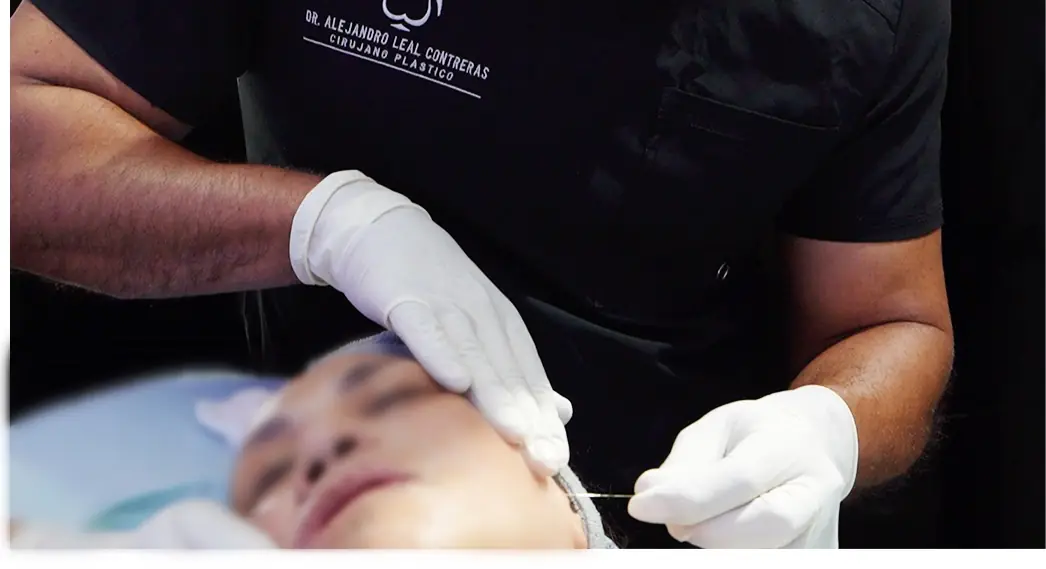
Dr. Leal at work in the operating room

Inside the operating room

Every operation on this page is performed in an accredited operating room, with a titled anesthesiologist present from start to finish.

Body contouring

Fat and loose skin are not the same problem

Liposuction removes fat. It does not remove skin, and it does not repair muscle. If your skin no longer retracts, or if the abdominal muscles separated during pregnancy, liposuction alone will make the problem more visible rather than less. This is the single most important distinction on this page, and it is what the examination settles.

These are also the procedures with the longest stay for patients flying in. Plan for 10 to 14 days in Guadalajara before you are cleared to fly home.

Abdomen · flanks · back

Lipo HD 360 (high-definition liposuction, Lipo Total Definer)

The clinic's flagship procedure. Fat is removed from the abdomen, flanks and back in one session — the full circumference, which is what the 360 refers to — working in both the deep and the superficial plane so that the shape underneath becomes visible. It is a contouring operation, not a weight-loss operation: the scale barely moves, the silhouette does. It demands more of you afterwards than ordinary liposuction, because compression and lymphatic drainage are part of the result, not optional extras.

Usually a candidate

  • Close to your goal weight, with localised fat that training has not shifted
  • Skin that still retracts
  • Willing to wear compression for weeks and attend the drainage sessions

Reviewed first if

  • You are looking to lose weight; this is not that operation
  • You have significant loose skin — that needs a tummy tuck instead of, or alongside, this
  • You smoke, or have diabetes that is not under control
  • You cannot commit to the post-operative routine; the result depends on it
Recovery garment 6–8 weeks
Abdominal skin

Tummy tuck (abdominoplasty)

Removes the apron of loose skin below the navel and, in most cases, repairs the separation of the abdominal muscles left by pregnancy. That muscle repair is the part liposuction cannot do, and it is why some women who train hard still have a lower abdomen that pushes forward. The scar runs low across the hips, hidden by underwear, and it is permanent. Liposuction of the flanks is frequently done in the same session.

Usually a candidate

  • Loose skin after pregnancy or after significant weight loss
  • Separated abdominal muscles that exercise has not closed
  • A weight that has been stable for several months

Reviewed first if

  • You are planning another pregnancy; wait
  • Your skin is still tight and the issue is only fat — that is liposuction
  • Your weight is still coming down; the result would be undone
  • You cannot arrange four to six weeks without lifting anything heavy, including small children
Recovery 2 weeks to desk work
Arms

Arm lift (brachioplasty)

For the inner upper arm that stays loose no matter how much you train. If the problem is fat with good skin tone, liposuction may be enough; if the skin has stopped retracting, usually after weight loss or with age, skin has to be removed, and that leaves a scar along the inner arm. Dr. Leal developed an arm suspension technique in November 2005 that he still uses in this procedure.

Usually a candidate

  • Loose skin on the inner arm after weight loss
  • A weight that has been stable for at least six months
  • You have seen where the scar goes and accepted it

Reviewed first if

  • The arm is fatty but the skin is still firm — liposuction alone does more with less
  • The scar runs down the inner arm and stays visible: worth seeing photographs of it before deciding
  • You are still actively losing weight
Recovery 6 weeks full activity
Thighs

Thigh contouring (liposuction or thigh lift)

Inner and outer thighs respond well to liposuction when the skin still retracts. When it does not — typically after large weight loss — skin has to be removed with a thigh lift, which leaves a scar in the groin crease or down the inner thigh. One thing worth saying plainly: cellulite is not treated by liposuction. Dimpling is caused by fibrous bands tethering the skin, and removing fat underneath can make it slightly more visible rather than less.

Usually a candidate

  • Localised fullness on the inner or outer thigh at a stable weight
  • Skin with reasonable tone, for the liposuction route
  • Loose skin after major weight loss, for the lift route

Reviewed first if

  • What bothers you is cellulite; this is not the treatment for it
  • You have untreated venous problems in the legs
  • You want a thigh lift result without accepting a thigh lift scar
Recovery garment 6–8 weeks
Definition

Muscle definition (high-definition etching)

Selective removal of fat along the natural grooves between muscle groups so that the muscle you already have becomes visible. It reveals; it does not build. If there is no developed muscle underneath, there is nothing to reveal, and the result looks artificial. It is also the procedure most dependent on what you do afterwards: gaining weight fills the same grooves back in.

Usually a candidate

  • Already training consistently, with muscle under a thin layer of fat
  • Lean, and intending to stay that way
  • Wants definition rather than a change in size

Reviewed first if

  • You do not train and do not intend to start; the pattern will look drawn on
  • Your weight fluctuates by several kilos through the year
  • You are hoping this replaces the gym rather than showing what it produced
Recovery gym at ~4 weeks
Combined

Two procedures in one session

Combining is sometimes the better decision and sometimes the dangerous one. It is better when the areas are compatible in the same surgical position and the total operating time stays within a safe window: one anesthetic, one recovery, one trip. It is dangerous when it stretches the surgery beyond that window, because complication rates rise with time under anesthesia. The limit is set by your health and by the clock — never by what is convenient to book.

Worth asking about if

  • You are travelling in and want to resolve everything on one trip
  • The areas are adjacent, such as abdomen and flanks

Split into two stages if

  • The combination would push operating time past what is safe for you
  • The two procedures need opposite positions on the table
Decided in assessment

Buttocks

The one where the risk has to be said out loud

Buttocks

BBL (gluteal fat transfer)

Fat is taken by liposuction from the abdomen, flanks or back, processed, and injected into the buttocks to add volume and change shape. Because the fat comes from you, the waist is contoured in the same operation, which is a large part of why the silhouette changes so much. Part of the transferred fat is reabsorbed over the first months — that is normal and it is accounted for in the plan, not a complication.

Usually a candidate

  • Enough donor fat elsewhere on the body to harvest
  • A stable weight, since losing weight later also loses transferred fat
  • Able to avoid sitting directly on the buttocks for the first weeks

Reviewed first if

  • You are very lean and there is not enough fat to move
  • You cannot organize two to three weeks without sitting normally — including the flight home
  • You want a size that would require fat to be placed where it is not safe to place it
  • You are comparing clinics on price alone; on this procedure that is the wrong variable
Recovery no sitting 2–3 weeks
The BBL carries the highest documented mortality rate in aesthetic surgery: reported figures range from about 1 in 3,000 to 1 in 15,000. We would rather you read that here than find it after you have paid a deposit somewhere else.

Why the number is what it is

The deaths are almost all caused by one mechanism: fat entering the large veins of the buttock and travelling to the lungs. That happens when fat is injected into or beneath the gluteal muscle, where those veins run. When fat is placed in the layer above the muscle, the risk falls dramatically.

This is why the plane of injection is not a stylistic preference, and why it is a fair question to ask any surgeon directly: in which layer do you place the fat, and how do you keep the cannula there? It is also why an accredited operating room and a titled anesthesiologist matter more on this procedure than on any other.

The other honest limit: the volume that can be transferred is set by your anatomy and by safety, not by a photograph. A surgeon who agrees to any size you name is not the safer choice.

Ask these questions in a consultation →

If your route stays out of surgery

Two of the four units never enter an operating room

Sometimes the honest answer is that you do not need surgery, or that you are not ready for it yet. That answer is easier to give in a clinic that has somewhere else to send you.

K-Laser Room — six technologies

Morpheus8 and FaceTite, BodyTite, AccuTite, K-Laser Blue and Blue Lifting. They do genuinely different things — some tighten skin from below, some work on texture from the surface, some address small areas the others cannot reach. Which one applies to you is decided in the same assessment as the surgical options, not by whichever one is being promoted.

Dr. Leal is a K-Laser Blue speaker for Mexico and Latin America.

Longevity Hub — fifteen treatments

A medical spa directed by plastic surgeons: biostimulators, facial rejuvenation, non-surgical body contouring and regenerative medicine. This is where results are maintained over the years, and where people who are not candidates for surgery still have something worth doing.

The Boutique covers what you use at home before and after: compression garments, medical-grade skincare and pigmentation protocols, thirty products priced from $400 to $23,000 MXN.

Stated plainly

The risks that apply to all of them

Every surgical procedure carries risk. These are the ones common to the operations on this page, and they are gone through with you in consultation before anything is signed.

  • Bleeding, haematoma and infection
  • Reaction to anesthesia
  • Blood clots in the legs or lungs, the risk that long flights add to
  • Fluid collection (seroma) needing drainage
  • Scars that widen, thicken or heal differently than expected
  • Asymmetry, contour irregularity or loose skin that persists
  • Changes in sensation, which may be temporary or permanent
  • A result that needs a second procedure to refine

Questions about choosing

Before you pick a procedure

How do I know whether I need liposuction or a tummy tuck?
Pinch the skin of your lower abdomen. If it is thick and springs back, the problem is likely fat and liposuction may be enough. If it is thin, loose, and stays where you leave it, skin needs to be removed. If your abdomen pushes forward at the midline when you tense, the muscles may be separated, and only a tummy tuck repairs that. The examination settles it; this is only what you are looking for.
Could the answer be that surgery is not the route for me?
Yes, and it happens. The most common reasons are a weight that is still changing, uncontrolled medical conditions, smoking, unrealistic expectations about what an operation can change, or simply that a non-surgical route makes more sense for now. Being told to wait is a clinical answer, not a rejection.
How many procedures can be done in one trip?
It depends on total operating time and on your health, not on your schedule. Adjacent areas in the same surgical position combine well. Two long procedures that need opposite positions on the table usually do not. The plan is built around what is safe for one anesthetic, and if that means two trips, you will be told before you book flights.
Will there be scars?
Liposuction leaves small incisions of a few millimetres that fade considerably. Skin-removing procedures — tummy tuck, breast lift, arm lift, thigh lift, facelift — leave real scars in planned positions, and they are permanent. Where each one goes is shown to you before you decide. A scar that fades is not a scar that disappears.
How long before I look like the final result?
You will look presentable long before you look finished. Swelling drops noticeably in the first month, keeps settling for three, and the last of it takes six months to a year on body contouring. Scars mature over a year or more. Anyone judging their result at week three is judging swelling.
Do I have to stop smoking?
For any procedure that lifts skin — facelift, tummy tuck, breast lift, arm lift — yes, and it is not a formality. Nicotine constricts the small vessels that keep the lifted skin alive, and the consequence of continuing is skin loss and a wound that will not close. You will be asked to stop for several weeks before and after.
What happens if the result is not what I hoped for?
You are seen, examined, and told honestly whether what you are looking at is swelling, normal healing at that stage, or something that genuinely needs revision. If revision is indicated, the terms — timing and what it costs — are discussed and put in writing rather than promised in advance. Most concerns raised in the first three months resolve on their own.
Is there an age limit?
Health matters more than the number. Fitness for anesthesia is assessed with lab work and, when indicated, cardiology clearance, and that assessment is what decides. At the other end, procedures on minors — otoplasty is the usual one — require that the child wants it, not only the parents.


Take the step

Bring the area.
We will tell you the procedure.

Consultations by video for patients outside Mexico, in your time zone.

WhatsApp Book a consultation